Today at 12:02

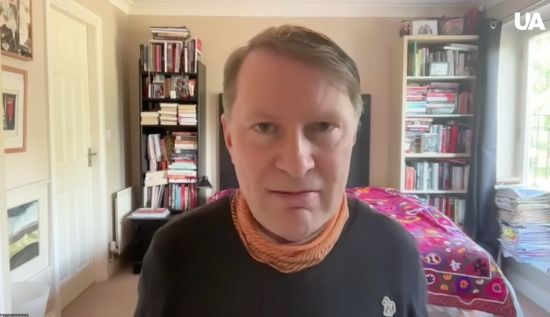
Today, former British Army Lieutenant Colonel Glen Grant joins us to analyze the brutal reality of Russia’s ongoing war against Ukraine and the West’s indecisive response. We will explain why Russia’s “human wave” tactics are still working, why Tomahawk missiles alone are not enough to change the course of the war, and how Ukraine must rethink its defense to survive. We will also examine the dangers of secret backchannel ceasefire negotiations and the weakness of Western leadership in its actions and responses.
Read more details from the interview between UATV English host Henry Keen and a former British Army Lieutenant Colonel Glen Grant.
— Ukrainian forces report more than a thousand Russian soldiers every single day. The Kremlin couldn’t kill us off, of course, not only because it’s the Kremlin and it never did, but also because it does not change anything, right? A thousand, ten thousand for them — slowly, knee high in blood. But are Russians gaining ground or not? And is it Ukrainians maybe who are gaining ground? What’s going on there?
— It’s a very difficult situation because actually both sides are intertwined, so you almost can’t say who’s gaining ground and who isn’t. The Russians are still pouring people forward. You say we’re killing a thousand soldiers a day, and still they come. But they made the decision two years ago that this is the way to fight — go back to the old ways of the Russian front and just pile men upon men upon men and work your way through. And they’ve been quite successful at it, and it’s going to remain successful. Even if we manage to hold the line, there may be a pause and there may even be a pause of PR, but I doubt it. I think they’re just going to keep the pressure on.
— That’s maybe a topic of a separate conversation because too many questions rise immediately after I hear answers like that from experts. But let’s slide smoothly to weapons. The American weapons — the US and NATO are sending more weapons now, discussing supply of Tomahawk missiles to Ukraine. Is that what Ukraine really needs now? Tomahawk makes sense?
— There’s no question that any long-range weapons will help the strategic battle. Absolutely. Whether the strategic battle is capable of changing the paradigm is still open to question. There is no doubt — absolutely no doubt — that there are a lot of Russians that are now unhappy because they can’t get their fuel and they can’t do what they want to do with their businesses, with lorry transport and stuff like this. So it is causing problems in the system. And I saw the video of youngsters chanting “get rid of Putin” in St. Petersburg. My concern is that they’re not chanting that because they want the West to be okay. They’re chanting that because they want the new leader to win the war. We still haven’t broken that paradigm of Russians saying, “This is a stupid thing to do, we shouldn’t be fighting.” That worries me because Tomahawk, I don’t think, is going to do that. It’s not going to have that effect.
The front line is the only way we’re going to win this war — to be sure of it — to make sure that we have enough soldiers on the front line and that they are properly equipped.
Not just equipped by volunteers, not just equipped by constant begging from people all over the world to give us another car and everything else, but just concentrating on what the boys on the front line need and giving it to them so that they can fight offensively, not just defensively.
— But the West is still too cautious — that’s what you’re saying? Slow and political actions?
— I think the West is cautious, and I also think that the linkage between the front line and the donors is still too fractured — going through the logistics, the General Staff, the Ministry of Defense. I don’t think the two are as coherent as they need to be. That also brings its own problems for the West, because then when the West is not totally committed to something, it doesn’t feel sure. I’ve heard the British and I’ve heard from other countries as well: “We’re giving what we’re asked to give.” They’re only delivering what they’re asked to deliver. They’re not delivering in some cases what they could deliver because they’re not asked to deliver that.
— That is a line that I’ve heard. Ukraine is not asking from the West what Ukraine needs?
— In some ways. If we asked the Japanese for two, three thousand cars — Toyota pickups — fair enough. And yet people are bringing cars from America, shipping them from America for the front line. Latvia has just sent — I can’t remember exactly how many, 150, something like that — to the front line. Other countries are doing it. Every day they’re asking for cars, which is something simple but absolutely fundamental. You can’t replenish yourself, you can’t go and buy batteries without a car to drive back and pick them up at the garage 30–40 kilometers back. These are fundamentals — part of the logistic system of an organized army. When you take that away, you’ve got soldiers wasting time to do things they shouldn’t have to do. You’ve got officers wasting time worrying about “where do we get this, where do we get that,” when those things should be supplied. Start with the cars. That will make a big difference to people. Ambulances.
— We hear that constantly. I’m not sure why it has not been done before, because this is a brilliant idea — to ask on a governmental level the Japanese to send not new, just used big cars.
— Easy. I don’t think that would be a very big problem for them. But I would just add this one thing: we’re looking for the silver bullet. We’ve been looking for the silver bullet since the beginning of the war. “We need this, we need F-16, we need this.” None of those silver bullets will actually change the paradigm. The only thing that will change the paradigm is the soldier. The man on the ground is actually the person — the thing — that will change things. And unless we enable those by training, by proper equipment for each individual, we will not go forward.
— Putin threatens the world again with nuclear escalation. This time the world just laughs at it openly — the reaction. You think?
— Very difficult to say, but I don’t think he’s going to use nuclear weapons because I think this is one step beyond — unless he’s got a suicide feeling in his own head, “I’m going to go down in a blaze of glory,” which is entirely possible. But I do think that the majority of his troops and the people around him would try to stop him because none of them want to go down in a blaze of glory. Don’t forget Lavrov’s got a house in the West, family in the West. So have many of the others. Most of the oligarchs have got houses and family in the West. They’re not going to want to lose all that just for this strange little dwarf in a bunker.
— I have two questions in one. Do you believe Putin will ever be held accountable for what he’s done? And will Western leaders have enough political will to actually launch and finish that?
— Two questions in one, isn’t it? The first question — do I believe he’ll be held accountable? No, because I think he’ll be killed by someone before he reaches that stage. Western leaders — most of them are so weak, aren’t they? This is the weakest bunch of men and women in power that the world has seen for thousands of years. Every one of them, 100–200 years ago, would have had their country taken over because they’re so lacking in spine. Germans are beginning to show a bit of fight, and I see that the AfD — a couple of them — are heading off to Russia to talk to Putin, so even Germany’s got internal problems. But I hope that even if Putin gets killed at the final curtain, we manage to put Lavrov, Gerasimov and a few others into The Hague and at least make some people suffer for a long time. And those people on television who constantly talk about killing — let’s see a few of those in The Hague for 20 years.
— If Putin escapes accountability, how do you think China, Iran, North Korea will interpret such a signal? Can they unite and destroy the West?
— I’m not sure they can unite to destroy, nor do I think that China wants to. China wants to buy and maneuver its way with small steps, because the Chinese look at long term. Why would you destroy things in a war if you don’t need to? Better to build a few more islands in the South Sea, take a bit more, and think about what you’re going to do over the next 300–400 years, because that’s the way the Chinese mind works. I don’t see them coming together to do something unless it was so critical that they had no choice. Each of them knows there’s a chance that if they do that, it’s going to destroy themselves. They’re survivors. They’re not megalomaniac in the way Hitler was. Putin is, but the others aren’t. They just want to destroy and damage and watch us break, using a different paradigm.
— Trump’s words about “progress towards peace,” hinting that peace is possible through negotiations, perhaps even through an agreement between Ukraine and Russia — is that illusions, delusions?
— It’s deluded. What worries me at the moment with the president’s administration in Ukraine is that they seem to be heading for elections or working towards elections, and if they are, then it means they’ve already made some sort of thought or agreement of a ceasefire, some sort of early peace agreement. But that doesn’t take into account the population, and I’m not sure that Ukraine as a whole is happy about that. Maybe they are, maybe we are here, but I’m definitely not sure.
— Do you believe these negotiations — Trump with Putin — are likely to happen?
— I think they’re going on all the time. Every day they’re talking. Don’t think that they’re not. My suspicion is the president’s administration is also talking all the time to someone, back door into Russia. I would not be surprised if things suddenly folded and we agreed. But it would take some sort of reinforcement of any agreement to be very obvious and clear. Anything except America is a joke. The rest of Europe still hasn’t got itself to a level where it could guarantee any support to Ukraine at all. Ukraine has got 150 brigades on the front line, and Europe can’t put 150 brigades on the front line. They can’t even replace the front line even if they want to. It would have to be US and US power — real power and all the firepower and all the enablers that the US has got. And Trump is not going to do that. He’s not going to put it there. He said that, and we all know he loves Putin. He would like to see some sort of agreement and then Putin take another big slice of the country. His team have even been endorsing that. The risk for Ukraine of people going around the back door behind them is very high.
— Is it that they are powerless because there’s not the choice, or is there no power?
— I think it’s political choice in their own countries — holding on to power and holding on to what they’ve got. And I think it’s crass ignorance that they just really don’t understand what this is all about. You can see it because the words that come out from them — there are not enough strong words on a daily basis, except from Germany. The rest of them are not talking in the right way. Macron comes up with idea after idea, but these are uncosted, unsupported ideas that he produces — he just throws them out every now and again to try and make him seem as though he knows what he’s doing, but he doesn’t. And Starmer in the UK is overwhelmed by the fact that his government is failing badly, so he hasn’t got the time or energy to put to a Ukraine war. He just has to leave it to his defense minister and not give him any more money. We’re left with what — Finland and Estonia.
— It’s just I don’t know what is more dangerous for Ukraine: losing Pokrovsk — which is not that crucial — or to wake up in the morning and say we already have an agreement and people just don’t know about it.
— Agreement is the most dangerous. There’s no question in my mind. Not facing up to the reality of a real war — which still the president’s administration are not doing — and not actually facing up to how we win this war. If they did, things would change quite quickly. If they started replacing second-rate people with first-rate people, started removing generals that are not competent and bringing back half the people they’ve sacked and put in reserve who are competent, stopped worrying about politics and worried about winning the war — then they’d actually win the politics. That’s the ironic part of it: if Zelenskyy wants another term, he needs to win, not to play politics. And he wins another term by doing what he doesn’t want to do: bring the best people back, win the war.
Read also: Military Observer Denys Davydov: “Putin won’t use nukes – but he’ll never stop this war”