Today at 09:02

Ukraine is hitting the foundation of Russia’s war machine harder and harder. In this new episode with British military expert Glen Grant, we analyze how the “Logistical Blockade” campaign is becoming one of the most dangerous threats to the Kremlin. As Ukrainian strikes disable oil refining capacity, fuel depots, and S-400 air defense systems, Russia is losing the ability to maintain the pace of war.
Why has the much-publicized “Oreshnik” become a symbol of Russia’s military technology failures? How serious are the consequences of strikes on Russia’s economy? And most importantly — why does the West still fear escalation, even as Ukraine demonstrates the ability to change the course of the war in its favor? We examine the Kremlin’s key miscalculations and the new battlefield reality where the initiative is increasingly shifting to Ukraine.
— Russia seems to be just watching the show, unable to shoot down Ukrainian drones. Is that really the case? Can’t they adapt fast enough? What’s going on?
— There are a lot of things going on. One factor is that Russia’s strength is also its weakness. Russia is huge. That means it simply cannot deploy enough air defense systems to cover the entire country.
The second issue is the quality of some of the personnel operating those systems. Air defense requires constant readiness and rapid reactions when missiles, rockets, or drones are incoming.
When you combine those two factors — the enormous territory and the human factor — you get serious vulnerabilities. And I mean the human factor quite seriously. We know that many soldiers fighting on the front line are not always in ideal condition, and that affects performance.
Russia clearly has a real problem with this. The results are visible to everyone. Their air defense systems are not as effective as many people expected them to be.
— The strike on the Torzhok oil pumping station in the Vladimir region showed that no safe zones really exist in Russia anymore. Around 40% of oil refining capacity is reportedly shut down.
What does that mean for Russia’s summer campaign?
— There are several knock-on effects. The first is the direct financial impact. If that 40% of production is offline, the government loses a significant amount of tax revenue.
The second issue is that many of the companies involved were already financially overstretched. Many of them took loans to operate and now their facilities have been damaged or destroyed. They still have to repay those loans.
That creates a downstream effect on the banking sector because banks invested heavily in those enterprises. If that money doesn’t come back, the banks themselves become vulnerable.
So the vulnerability isn’t only about reduced oil production affecting military logistics. The entire financial system becomes shakier.
And there is no large reserve of money available to stabilize that financial system because the government needs virtually all available resources to sustain the war effort — paying soldiers, funding recruitment, and maintaining military operations.
— Speaking of recruitment, I believe Putin must fear a major mobilization wave, but we’ll come back to that later.
For now, let’s talk about the destruction of enemy logistics and air defense.
While strategic targets are burning deep in the Russian rear and in occupied territories, the Armed Forces of Ukraine continue systematically destroying some of Russia’s most expensive military assets. Ukraine is effectively creating a kill zone roughly 150 kilometers deep behind the front line, which is helping contain occupation forces.
For example, the destruction of several Su-24 and Su-30SM aircraft at a Russian air base in Crimea and the destruction of an S-400 system in the Kherson region suggest to me that there is a systemic crisis in Russian air defense.
Where are these supposedly invincible Russian air-defense umbrellas? Why do they seem so vulnerable?
— I think it goes back to what I said earlier. The overall system simply isn’t working as effectively as many people assumed.
And who ever proved that Russia had a super air-defense system in the first place? There was a tremendous amount of hype surrounding systems like the S-400 and other Russian weapons.
But in practice, they have not performed at the level many expected.
— Recently a British Storm Shadow missile reportedly struck a heavily protected command post in the Luhansk region, eliminating another occupation headquarters.
How would modern military science evaluate the loss of a headquarters at that level during active offensive and defensive operations? Does it really matter for a large army like Russia’s?
— It absolutely matters. The army may be large, but you still need people coordinating movement, organizing supplies, delivering water, food, ammunition, and managing operations.
When you strike headquarters, you inevitably create delays and disruption.
But the key point is coordination. When you destroy a headquarters, you create an opportunity for a counterattack. If you don’t exploit that opportunity, the enemy eventually reorganizes and establishes a new headquarters.
That’s why military operations need to be synchronized. Front-line operations, mid-range strikes, and long-range attacks should all be coordinated in a cohesive manner.
The goal is to leave the enemy unable to function because multiple parts of the system fail simultaneously. We haven’t perfected that yet, but I believe we are getting closer. And if we get it right, the result won’t be isolated disruptions here and there. There will be a real fracture throughout the system.
At that point, the enemy begins to fall apart, and that fracture has to be exploited. That is how a military collapse develops.
— Otherwise, at the moment we’re still playing the frontal attack game rather than a maneuver game.
It’s encouraging to hear from a British colonel that we’re at least getting closer to some level of cohesion because the Ukrainian army five years ago was still heavily influenced by Soviet doctrine and certainly far from the British Army model.
Now we’re much closer to making the enemy gasp for air. And I think we should continue at that pace — perhaps even faster. Let me push you toward discussing the Russian command more generally.
Russia is trying to hide equipment and fuel depots using engineering structures and passive protection measures. Clearly, it’s not working. There are countless videos online showing everything burning. So how is Ukraine doing this? What is the magic wand that allows Ukrainian forces to detect and destroy hidden targets so accurately?
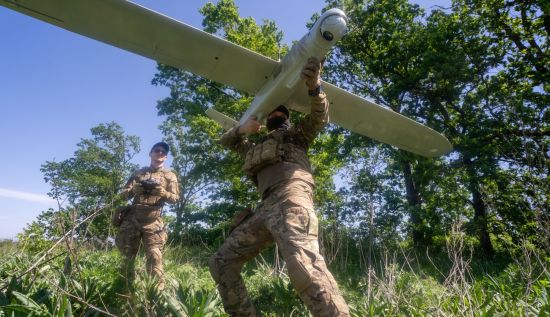
— There’s nothing magical about it. It’s simply good work. You fly a drone, identify what’s there, then send another drone to destroy it. And we’re getting progressively better at doing that all the time.
The next stage is actually more complex. It involves using negative data, not just positive data. By negative data, I mean information that tells you where the enemy is not. You identify empty areas, find the gaps, and move into them.
There is actually far more negative data than positive data because even though Russia has a large army, it leaves gaps everywhere. For a long time we’ve been sitting back, waiting for them to attack again. Understandably so. But we need to seize the initiative.
What the Ministry of Defense is doing now with different drone systems is giving commanders a greater ability to strike deep into enemy territory. Not just with FPV drones or small commercial drones, but with systems that provide real range and reach.
There’s no point in having a drone that can identify a target 120 kilometers away if you don’t have a strike drone capable of reaching it. So surveillance and strike capabilities have to be matched. Those capabilities then need to be given to corps commanders and distributed down to brigades so they can conduct long-range attacks.
But long-range attacks must then be followed by movement on the ground. You cannot simply sit back and destroy targets at a distance forever. The enemy will adapt. If one road is blocked, they’ll find another.
That’s why we need real coherence in operations.
As I said, I can see that developing, but it’s not magic. It’s doctrine, coordination, planning, and more planning. The key is ensuring you have resources before launching an operation, not after it has already begun. Military logistics usually work on what we call a “day-for-day” basis. You receive enough supplies for one day and conduct one day’s worth of fighting.
If you want to launch a major offensive, you need to spend days building reserves.
Maybe for five, six, seven, eight, ten, even fifteen days you deliberately consume less than you receive so that reserves accumulate. Every couple of days you create another day’s worth of spare ammunition and supplies. Before even considering a major attack, you need several days of reserves. If you can accumulate fifteen or twenty days, then you know you can attack, continue attacking, and maintain momentum.
If you remember the offensives of 2023, we started strongly, made progress, and then ran out of steam. We cannot afford that anymore. If we go, we have to keep going.
— Let’s talk about tactical breakthroughs, air-defense effectiveness, and what some call the Kremlin’s technological bluff. Along the front line, the high-tech approach of the Ukrainian defense forces allows them to stop mechanized assaults before Russian forces have fully deployed into attack formations.
At the same time, the Kremlin responds with large-scale missile terror, which we’ve all seen, and what appears to be a demonstration of technological incompetence by the Russian military-industrial complex. Let’s find out whether that’s really the case.
According to some analysts and official reports, Ukrainian forces have liberated more than 590 square kilometers of territory since the beginning of the year, including areas such as Mala Tokmachka, which Russian reports seem to claim they capture almost every month.
Could you identify a specific tactical solution — or combination of solutions — that allows Ukrainians to turn the tide?
— It really is just good work. There is no magic. It’s coordination, cooperation, and effective performance at every level. That last point is crucial. You cannot have excellent brigades if the corps headquarters performs poorly.
If a corps headquarters wants its brigades to gain territory, it has to conduct serious planning and coordinate with army headquarters and the Ministry of Defense. As I mentioned earlier, resources must be positioned ahead of the operation. That is a planning function. If you fail to do that, then the moment an offensive begins, you immediately start consuming two, three, or even four days’ worth of ammunition in a very short period of time.
And if you haven’t prepared for that beforehand, your offensive loses momentum almost immediately.
— Let’s talk about the so-called Oreshnik missile. The missile that reportedly destroyed a private garage in Bila Tserkva.
Is that really an example of Russian weapons superiority, or is it simply nuclear blackmail? It’s supposedly a nuclear-capable missile. If that’s the case, it must be one of the most pathetic examples imaginable. Are we going to see more of this? What’s next — nuking fish in a pond? And it’s an expensive weapon, isn’t it? Fifty million dollars? One hundred million dollars?
— You have to look at the broader picture. These systems have been neglected for a long time. Russia has not been investing properly in them. Firing one of those missiles with a concrete training warhead tells us several things, although I’m not entirely sure which explanation is correct.
First, all missiles have training warheads. You do not keep missiles permanently loaded with nuclear or explosive warheads. The missile and warhead are stored separately and combined before launch.
It’s possible they were ordered to launch two missiles but simply could not obtain another explosive warhead quickly enough. Maybe it was hundreds of kilometers away. Maybe the person responsible for the storage facility was unavailable. These kinds of mundane explanations do happen.
Second, these missiles are not new. They are not some magical new technology. They have existed for a long time. Missiles require constant maintenance, and maintenance is expensive. Russia has neglected that maintenance for years. Western intelligence agencies have known for a long time that parts of Russia’s nuclear delivery systems are not in ideal condition.
Remember, nuclear warheads are not stored on the missiles themselves. These missile units operate much like ordinary military units.
Have they been training properly? I doubt it. Missile units conduct relatively little training because it is expensive to move these systems around and practice with them. Personnel become bored. They are not on the front line and are not facing the same pressures as combat units. Then suddenly someone orders them to launch a missile. They respond: “We don’t have the warheads.” And someone says: “We can get you one immediately, but the others are still in storage.” This is real life. This is how military organizations function.
I served in a nuclear regiment. I know how these things work. So a neglected part of the system is suddenly ordered into action and it simply isn’t ready. One missile launches and lands where it shouldn’t. Another launches with a concrete training warhead. That concrete warhead changes the missile’s weight and therefore its ballistic characteristics. As a result, it lands somewhere it was never supposed to land — in this case, somebody’s garage.
Thankfully it landed in garages. Because if it had landed on a school or somewhere else crowded, even a concrete warhead could have caused devastating casualties. We were lucky.
But this does not tell us what the next launch will look like or whether Russia has had enough time to correct those problems. Maybe they now have proper explosive warheads ready. Maybe they do not. Maybe explosives have been removed from warheads and repurposed elsewhere. We simply do not know.
But what we can say is that the system is creaking. The entire system is under strain for many reasons. Russia has repeatedly taken technically skilled personnel from missile regiments and other specialized units and sent them to the front because they need experienced officers and soldiers there. Every time you do that, you weaken the quality of the organization they came from.
They have been weakening missile regiments, nuclear units, air-defense regiments, and other technical organizations because they need personnel to manage the constant turnover at the front. You cannot keep doing that forever.
Eventually the quality of those organizations declines. And that is exactly what has been happening.
— Speaking of strain on the system, you’re in Latvia now, correct?
— Yes, I’m in Riga this week.
Interviewer: Russia is spoofing GPS signals from Kaliningrad. We all know that.
It is deliberately trying to interfere with navigation, throw Ukrainian drones off course, and in some cases redirect them into Baltic airspace — including Latvia, where you are now. You’ve said before that this exposes serious weaknesses in the region’s security architecture.
From a military perspective, why do NATO countries still limit themselves to documenting these incidents rather than taking stronger technical countermeasures against Russian electronic warfare systems?
— That’s a fair question. We recently saw two drones strike an oil terminal. Another drone disappeared entirely and nobody knows where it went. There was also a drone in Estonia that was shot down by NATO air-policing aircraft. Then last night a drone struck an apartment building in Romania and injured a civilian.
And all we heard afterwards were the usual statements about NATO protecting its members and expressions of concern. We were incredibly lucky. Had that drone struck the building at a slightly different angle, there could easily have been several fatalities.
So why isn’t NATO doing more? You can call it caution, fear, or something else. But many people are frightened of taking the next step. Russia has traditionally been strong in two areas: electronic warfare and artillery.
They have lost much of their artillery advantage because of drones, but they remain highly capable in electronic warfare. They are still very good at it. They continue adapting and evolving in that area. The bigger problem is geopolitical. NATO is struggling with this challenge.
Many countries still do not fully understand what drones and electronic warfare have done to modern warfare or the scale of that transformation.
Some still believe that technological solutions will soon remove drones from the battlefield and allow a return to traditional maneuver warfare. I’m not convinced that will happen.
— Well, Mr. Grant, we’ll see what happens. Thank you very much for your time. Every time we speak, I feel my level of military understanding rises a little higher. I hope the same is true for our viewers.
— We are going to win. I’ve said it all along. We are going to win. We are getting better. We just need to keep going and not allow Russia to secure some kind of half-peace, frozen peace, or manipulated peace.
Russia is on the back foot. The initiative has shifted to Ukraine.
Read also: Ukraine says no peace deal possible without U.S. leadership, seeks stronger European role