Today at 09:01
Ukraine’s latest large-scale strike on targets around Moscow demonstrated the effectiveness of Kyiv’s strategy of overwhelming Russian air defenses with waves of drones, according to analysts interviewed by CNN, UATV English reports.
Markus Schiller, a weapons expert at the Stockholm International Peace Research Institute (SIPRI), said Russia’s chaotic response and incidents in which air-defense missiles struck their own infrastructure showed longstanding weaknesses in Russian systems.
“Russia has repeatedly experienced situations where older systems were not 100% reliable,” Schiller said, adding that Ukraine has been steadily improving its offensive capabilities for years.
Stuart Ray, a senior analyst at McKenzie Intelligence Services, pointed to footage showing Russian forces firing man-portable air-defense systems from a busy highway. He described the response as rushed, improvised, and unprofessional.
“The complete absence of traffic control and the use of military equipment in extremely close proximity to civilian vehicles and people support that assessment,” Ray said.
Thomas Withington, a military sciences researcher at the Royal United Services Institute (RUSI) in London, argued that Russian air defenses are fundamentally ill-suited to counter large-scale drone attacks.
“Russian air defenses are simply not fit for purpose. They are not designed to detect, track and defeat attacks of this kind,” Withington said, adding that Western sanctions have limited Moscow’s access to technologies needed to develop more effective systems.
He noted that detecting drones on radar is not the same as maintaining high-quality tracking and stressed that hundreds of drones approaching from multiple directions require a level of coordination Russia’s integrated air-defense network has failed to achieve.
CNN also noted that repeated long-range Ukrainian strikes have fueled speculation that Russia could eventually face shortages of interceptor missiles. While the exact size of Russia’s stockpiles remains unknown, analysts said continued high-intensity attacks could gradually deplete them.
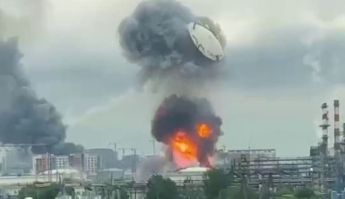
Ukraine struck the Moscow Oil Refinery on June 16 and launched another mass attack on June 18, hitting the facility in Kapotnya for the second time in a week.