Today at 14:21

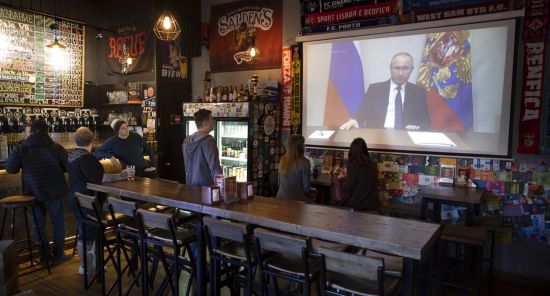
Russian President Vladimir Putin rejected a peace proposal from the United States and Ukraine during a meeting with a U.S. delegation in Moscow on December 2, and is unlikely to accept any compromise that does not align with his original war goals, according to a report by the Institute for the Study of War (ISW), UATV English reports.
The meeting involved Putin, his aide Yuriy Ushakov, and Kremlin special envoy Kirill Dmitriev, who met with U.S. Special Envoy Steve Witkoff and Jared Kushner, the son-in-law of former U.S. President Donald Trump.
After the talks, Ushakov stated that the U.S. and Russia discussed “several options” for a peace settlement but failed to reach agreement on a “compromise plan.” He added that some U.S. proposals were acceptable to Russia, while Putin expressed a “critical or negative attitude” toward others.
Ushakov also claimed the parties did not discuss “specific wording or concrete proposals,” but focused on the “essence” of the documents the U.S. had previously submitted to Moscow.
According to the Russian account of the meeting, the delegations discussed “territorial issues” and “enormous prospects” for U.S.–Russian economic cooperation.
Ushakov further said both sides agreed not to disclose the substance of the negotiations, which ISW notes is consistent with its December 1 forecast that the Kremlin would avoid public discussion to obscure Russia’s rejection of the peace proposal.
ISW stresses that senior Kremlin officials, including Putin, have consistently rejected the 28-point peace plan and its later versions since they first emerged in mid-November 2025, because the proposals did not satisfy Russia’s maximalist war objectives.
ISW also cites NBC News, which reported—based on sources ahead of the meeting—that Russia is not willing to compromise on:
- the territories of Donetsk and Luhansk,
- demands to limit the size of Ukraine’s armed forces,
- and Moscow’s insistence that the U.S. and Europe recognize occupied Ukrainian territories as Russian.
The analysts argue that leaks from Kremlin insiders to the U.S. media were likely meant to project Russia’s readiness to compromise on “secondary issues” in exchange for concessions from Ukraine and the West, while masking Putin’s true objective — control not only over the entire Donbas, Zaporizhzhia, and Kherson regions, but all of Ukraine.
ISW also notes that Putin has attempted to pre-emptively blame Europe for Russia’s refusal to accept any version of the “peace plan” ahead of the December 2 talks.
Kremlin officials have repeatedly signaled in recent weeks that they will not accept any settlement that fails to meet Russia’s maximalist demands — including the U.S.-proposed 28-point initial plan.
According to ISW, the Kremlin is likely creating conditions to blame Europeans for inserting “unacceptable” provisions into the peace proposal, using Europe as a scapegoat for Moscow’s obstruction of the peace process.
Earlier, on November 30, U.S. and Ukrainian delegations met in Florida to discuss Ukraine’s peace plan.
Ukraine’s National Security and Defense Council Secretary Rustem Umerov said the talks resulted in significant progress toward a just peace and greater alignment between Kyiv and Washington.
U.S. Secretary of State Marco Rubio called the meeting productive but noted that much remains to be done.
The White House described expectations for the peace process as “very optimistic” and confirmed Witkoff’s Moscow visit as part of “shuttle diplomacy.”
Witkoff and Kushner arrived in Russia on Tuesday and met with Putin and his representatives.
The Kremlin called the talks “useful” but stressed that no compromise peace plan was achieved.
Rubio stated that the United States is working to help resolve the war in Ukraine and bridge differences between the parties, but emphasized that the decision to end hostilities will rest with Kyiv and Moscow.