Today at 13:25

In January, the FREEДОМ audience showed high interest in reports about the meetings of the President of Ukraine with international partners, his reaction to Maduro’s arrest, sharp statements in Davos, information about shelling of civilian infrastructure in Ukrainian cities by the Russian army during severe frost, developments at the front, strikes by the Ukrainian Defense Forces deep in enemy territory, and materials about the historical and civilizational incompatibility of the Caucasus with Russia’s imperial model.
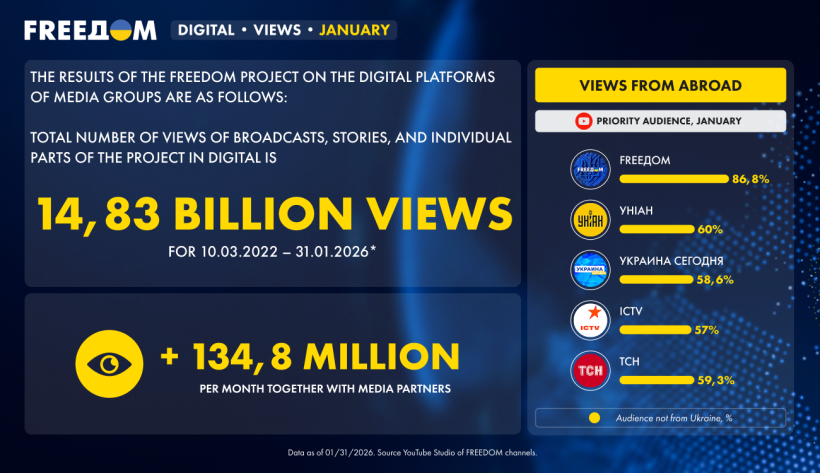
Compared to December, FREEДОМ views increased on Facebook, Telegram and TikTok. In addition to the traditional cities of Moscow, Saint Petersburg, Almaty, Bishkek and Dushanbe, Riga and Minsk entered the top cities by views. In January, FREEДОМ content on digital foreign broadcasting platforms (YouTube, Facebook, TikTok, Telegram, X, WhatsApp) gathered 59.1 million* views, including 27.8 million on YouTube; 11.6 million on Facebook (in December – 10.9 million); 14.3 million on Telegram (in December – 9.7 million); 4.4 million on FREEДОМ TikTok (in December – 4.1 million) and 1 million on FREEДОМ.CAUCASUS TikTok. In total, on the digital platforms of the State Enterprise “MPIU” and partners, FREEДОМ content in January gained 134.8 million views (over 46 months of operation — 14.83 billion views**).
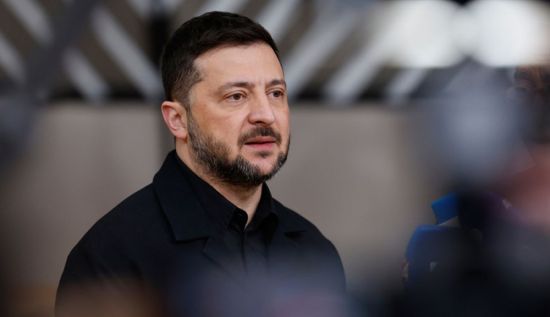
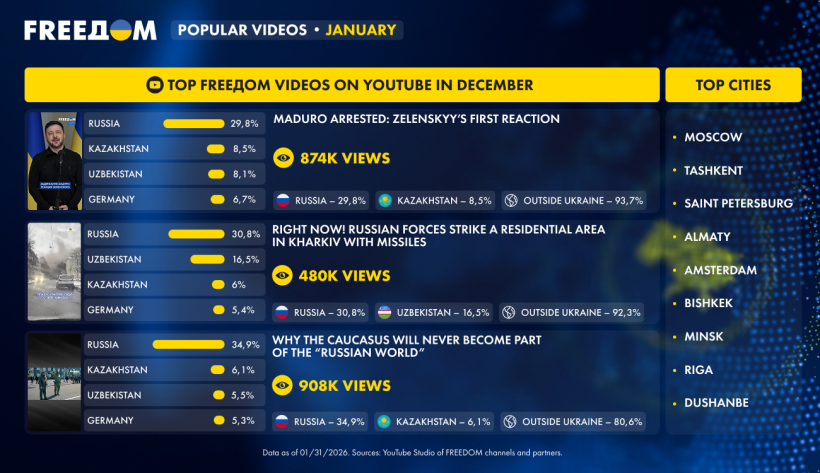
The international track remained in the focus of the FREEДОМ editorial team and viewers. The highest number of views was collected by a video featuring Volodymyr Zelenskyy’s reaction to the U.S. special operation in Venezuela, in which the head of the Ukrainian state noted that the United States, having acted this way with a dictator, knows what to do next. In total, this fragment was viewed 1.1 million times***: 874 thousand on the FREEДОМ YouTube channel and 227 thousand on FREEДОМ.LIVE — 93.7% of views came from abroad. Foreign broadcasting viewers also actively followed the participation of the Ukrainian delegation in the World Economic Forum (WEF) in Davos. Statements and the speech of Volodymyr Zelenskyy together gathered more than 510 thousand views on the FREEДОМ and FREEДОМ.LIVE platforms, 90% of the audience from abroad, one third from Russia.***
Statements by the newly appointed Head of the Office of the President, Kyrylo Budanov, in Davos, reminding that the bloodiest war in Europe since 1945 is ongoing and calling on partners to support Ukraine on the path to lasting peace, together received more than 300 thousand views on YouTube, most from Russia, Uzbekistan and Kazakhstan. Footage of Kyrylo Budanov arriving at the “coalition of the willing” meeting in Paris was viewed 290 thousand times, 33% of views from the Russian Federation. There was also high interest in materials about Volodymyr Zelenskyy’s official visits to France, Cyprus, Switzerland and Lithuania, as well as meetings with the Foreign Minister of Albania and the President of the Czech Republic. The various stages of peace negotiations were also a cross-cutting theme in January, including coverage of the visit of the Ukrainian negotiating group to the United States for consultations and a trilateral meeting in Abu Dhabi.
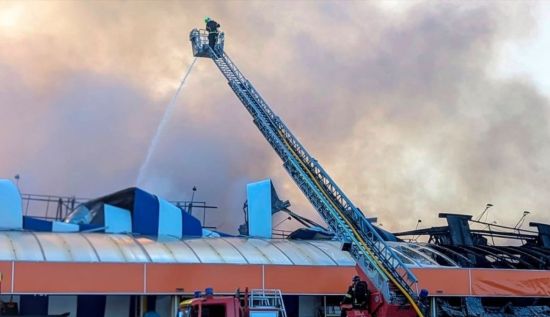
During the month, reports on massive shelling of Ukrainian cities by the Russian army, which caused large-scale destruction of critical infrastructure and outages of electricity, water and heating, became resonant. An emotional statement by Yurii Fedorenko, commander of the 429th Separate Brigade of Unmanned Systems “Achilles” of the Armed Forces of Ukraine, emphasizing that Russian soldiers are not blind executors but conscious executioners who deliberately target residential buildings and schools at night, received more than 1.1 million views. Footage of the consequences of the massive shelling of Kharkiv and a hit on a high-rise building gathered 480 thousand views. Among the resonant stories was a report on the consequences of nighttime strikes in the capital: power and heating outages, the heroic work of Ukrainian rescuers and the rescue of people from under the rubble despite repeated cynical shelling by the Russians. In total, materials about Russia’s terrorist attacks against Ukraine during the month gathered more than 6 million views.
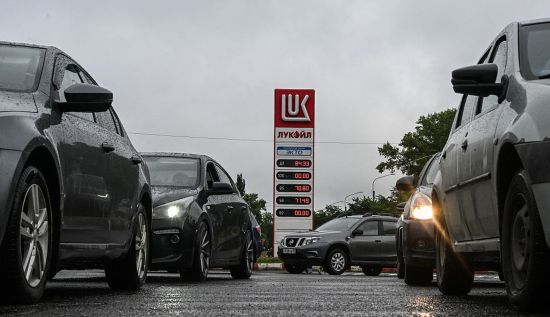
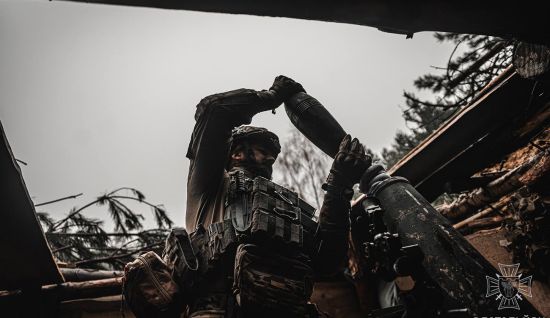
Developments at the front are always in the focus of FREEДОМ. In January, videos about the situation in Huliaipole and successful strikes by the Defense Forces on facilities in the Russian rear were popular. More than 200 thousand views were collected by news about damage to an oil refining facility in Rostov-on-Don as a result of a drone and missile attack (more than 30% of views from Russia). The editorial team also always places special emphasis on discrimination against indigenous peoples within the ranks of the Russian army. Thus, one of the episodes of the project “News of Free Peoples” hosted by Kyrylo Volnyi was devoted to intensified recruitment for the war in Tatarstan and Bashkortostan — this topic was discussed with experts and representatives of indigenous peoples.
On the FREEДОМ.CAUCASUS YouTube channel, thematic streams had high viewership. A nine-hour broadcast in which participants discussed the civilizational differences between the Caucasus and Russia, why the empire failed to subjugate the region for two hundred years, and how the peoples of the Caucasus are gradually restoring their political subjectivity, was viewed 908 thousand times, 81% of the audience from abroad, 34.9% of viewers from Russia and 6.1% from Kazakhstan. The stream about pressure by authorities on teachers in Chechnya, the forgotten tragedy of the New Year’s assault on Grozny in the 1990s, and the activities of the Chechen diaspora abroad, which continues political and cultural struggle despite pressure, threats and attempts at discreditation, gathered 410 thousand views. In total, views of the FREEДОМ.CAUCASUS YouTube channel in January amounted to 5.7 million. Among the leading cities by views: Moscow, Tashkent, Saint Petersburg, Dushanbe, Bishkek, Almaty, Grozny. Another 1 million views were collected by FREEДОМ.CAUCASUS content on TikTok.
In January, the FREEДОМ channel premiered the documentary-analytical project “By the Laws of the Kremlin: Behind-the-Scenes Secrets of Russian Power” with Yurii Kulinich about the real structure of power in the Russian Federation and Putin’s inner circle, which for more than 25 years has formed a clan-based system of governance. The first episode tells about the origins of this system in the 1990s — the rise of Putin’s power, the role of security services and business elites, and the transformation of administrative resources into a key instrument of control.
* Total view indicators on all own digital platforms of the State Enterprise “MPIU”: YouTube, Facebook, TikTok, Telegram, X, WhatsApp. Data sources: digital platform analytics tools; Google Analytics; YouTube Studio of FREEДОМ channels. Period: January 2026.
** Total indicators on all digital platforms (YouTube, Facebook, TikTok, Telegram) of the State Enterprise “MPIU” and on partner platforms — Ukrainian media groups broadcasting content under the FREEДОМ brand. Data sources: digital platform analytics tools; Google Analytics; YouTube Studio of FREEДОМ and partner channels. Period: January 2026.
*** Refers to the total number of views of videos of the specified topic on the FREEДОМ and FREEДОМ.LIVE YouTube channels.
ABOUT FREEДОМ
FREEДОМ is a Ukrainian state foreign broadcasting channel oriented toward a Russian-speaking audience outside Ukraine. The on-air TV channel broadcasts via satellite, cable, DTH, IPTV networks of national operators and on OTT platforms. In digital, it is represented on 14 Internet platforms, on YouTube, Facebook, TikTok, Telegram, X and WhatsApp. The FREEДОМ channel is part of the State Enterprise “Multimedia Platform of Foreign Broadcasting of Ukraine.” The State Enterprise “MPIU” is a stable, multi-level institution in the state’s information security system, which includes ten media brands — FREEДОМ, “Dim,” UATV.English, UATV.Arabic, UATV.Español, The Gaze, UATV.Português, UATV.Deutsch, UATV.Türkçe, UATV po polsku — which produce and broadcast content in nine languages: Ukrainian, English, Russian, Arabic, Spanish, Polish, Portuguese, German and Turkish.