Today at 11:40
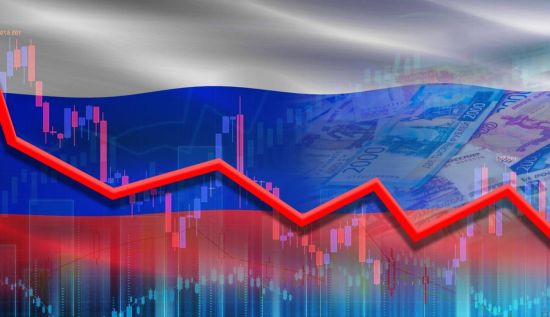
Russia’s stock market suffered its sharpest one-day decline in nearly four years on June 22, as investors reacted to a combination of economic pressures, geopolitical uncertainty, and concerns over the country’s fiscal outlook, UATV English informs.
According to TMT, the Moscow Exchange (MOEX) Index dropped by 4.65% during Monday’s trading session, marking the largest daily fall since September 2022, when Russian President Vladimir Putin announced a “partial mobilization” campaign following military setbacks in Ukraine.
The decline extended a prolonged downward trend that has seen the Russian market remain in negative territory for 15 consecutive weeks.
At the close of trading, the MOEX Index, which tracks 46 of Russia’s largest publicly traded companies, stood at 2,318.2 points—its lowest level since March 2023.
Major Russian companies recorded significant losses across the board. Gazprom shares fell by 4.4%, reaching their lowest level since late 2008. Rosneft posted its steepest daily decline since 2022, losing 7.3%.
Other major companies also experienced substantial declines. Shares of Novatek, VTB, and Aeroflot each dropped by more than 5%, while Lukoil and Rostelecom fell by over 3%.
Investment banker Yevgeny Kogan said investor sentiment has deteriorated to the point where panic selling is becoming increasingly evident.
According to Kogan, several factors are contributing to the market’s weakness. These include the absence of progress toward negotiations aimed at ending the war against Ukraine, the Russian Central Bank’s decision to maintain high interest rates, and continued Ukrainian strikes against Russian infrastructure.
He argued that attacks on energy and transport facilities have increased concerns about potential disruptions to fuel supplies, which could place additional upward pressure on inflation.
Another factor weighing on investor sentiment is the prospect of lower global oil prices. Analysts note that the United States recently eased restrictions on Iranian oil exports, potentially increasing global supply and reducing revenues for Russian energy exporters.
Concerns also intensified after comments by veteran Russian politician Gennady Zyuganov, who suggested the possibility of confiscating public bank deposits.
According to Finam analyst Dmitry Lozovoy, investor anxiety increased significantly following those remarks.
“After these comments, the sell-off accelerated noticeably, as investors became more concerned about potential administrative pressure on the financial sector and private savings,” Lozovoy said.
The market’s broader decline has been substantial. Since mid-March, the MOEX Index has lost approximately 20% of its value. Compared with the highs reached in 2024, when optimism surrounding possible negotiations between Vladimir Putin and U.S. President Donald Trump boosted investor sentiment, the index has fallen by roughly 30%.
Analysts at Vector Capital argued that geopolitical developments remain the primary factor influencing the market’s outlook.
“Only geopolitics can fundamentally change the situation. Most of the other negative factors are ultimately consequences of sanctions and the restrictions imposed on Russia,” the analysts said.
The latest market downturn highlights the growing economic pressures facing Russia as the war continues, sanctions remain in place, and uncertainty surrounding future energy revenues and investor confidence continues to weigh on the country’s financial markets.
Read also: Ukraine to Expand Deployment of Experimental Anti-Drone Systems, Syrskyi Says