Today at 21:26

Leaders of several European countries and EU institutions issued a joint statement welcoming “significant progress in President Trump’s efforts to secure a just and lasting peace in Ukraine”, UATV English reports.
The text of the statement was published by the press service of the German government.
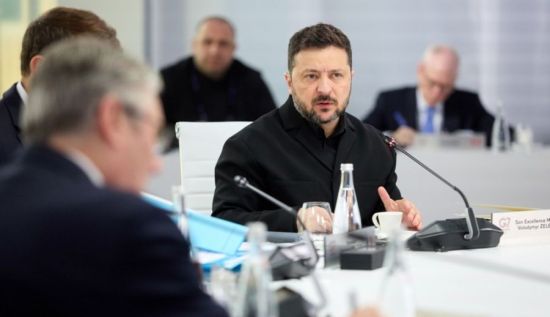
The statement also notes that the leaders welcomed the close cooperation between the teams of President Zelensky and President Trump, as well as European teams, over the past days and weeks.
European leaders agreed to work with Trump and Zelenskyy “to achieve a lasting peace that preserves Ukraine’s sovereignty and European security.”
“The leaders agreed that ensuring Ukraine’s security, sovereignty, and prosperity is an integral part of broader Euro-Atlantic security. They clearly stated that Ukraine and its people deserve a prosperous, independent, and sovereign future, free from fear of future Russian aggression,” the statement emphasizes.
In addition, U.S. and European leaders “committed to working together to provide Ukraine with robust security guarantees and measures to support economic recovery in the context of an agreement to end the war.”
Among these commitments, the statement lists the following:
- To provide Ukraine with sustained and substantial support to build its armed forces, whose size should remain at 800,000 personnel in peacetime, enabling them to deter conflicts and defend Ukraine’s territory.
- To establish, under European leadership, “multinational Ukraine forces” composed of volunteers from countries participating in the “coalition of the willing,” with U.S. support. These forces will contribute to rebuilding Ukraine’s armed forces, ensuring the security of Ukraine’s airspace, and supporting maritime security, including through operations on Ukrainian territory.
- A U.S.-led monitoring and verification mechanism for the ceasefire, involving international organizations, to provide early warning of any future attacks, identify perpetrators, respond to violations, and include a conflict-resolution mechanism to develop mutual de-escalation measures that may be taken for the benefit of all parties.
- A legal commitment, subject to national procedures, to take action to restore peace and security in the event of a future armed attack. Such measures may include armed forces, intelligence and logistical assistance, as well as economic and diplomatic actions.
- To invest in Ukraine’s future prosperity, including providing significant resources for recovery and reconstruction, concluding mutually beneficial trade agreements, and taking into account the need for Russia to compensate for the damage inflicted on Ukraine. In this context, Russian sovereign assets in the European Union have been frozen.
- To firmly support Ukraine’s accession to the European Union.
All parties committed to working toward rapid further progress in the coming days and weeks in order to jointly conclude and approve an agreement on lasting peace. They reaffirmed their strong support for President Zelenskyy and the people of Ukraine in their struggle against Russia’s illegal invasion and in achieving a just and lasting peace.
The leaders expressed their support for Zelenskyy and agreed to support any decisions he ultimately makes regarding specific Ukrainian issues.
They confirmed that international borders cannot be changed by force. Decisions regarding territory belong to the people of Ukraine, once reliable security guarantees have been effectively implemented.
They agreed that certain issues will need to be resolved at the final stages of the negotiations.
“They clearly stated that, as in any agreement, nothing is agreed until everything is agreed, and that all parties must work intensively toward a solution that could ensure a lasting cessation of hostilities,” the statement stresses.
The statement was signed by German Chancellor Friedrich Merz; Danish Prime Minister Mette Frederiksen; President of Finland Alexander Stubb; French President Emmanuel Macron; Italian Prime Minister Giorgia Meloni; Dutch Prime Minister Dick Schoof; Polish Prime Minister Donald Tusk; Norwegian Prime Minister Jonas Gahr Støre; Swedish Prime Minister Ulf Kristersson; UK Prime Minister Keir Starmer; as well as the heads of the European Commission and the European Council, Ursula von der Leyen and António Costa.
Earlier, Sky News reported that an anonymous U.S. official said that during the Ukraine–U.S. talks in Berlin, “90% of contentious issues” between Ukraine and Russia had been resolved.
Secretary of the National Security and Defense Council Rustem Umerov expressed hope that by the end of the day the U.S. and Ukrainian sides would be able to align positions that would “bring Ukraine closer to peace.”
According to AFP, during the Berlin talks, U.S. negotiators Steve Witkoff and Jared Kushner pressured the Ukrainian side to renounce the part of Donbas under its control.
Following this, Deputy Foreign Minister Serhii Kyslytsia urged not to believe anonymous sources regarding the U.S. position in the negotiations.
Read also: Zelenskyy on talks with the United States: the discussion was productive and detailed